What Are Finish-Cut Tow Mowers—and When Should You Use One?
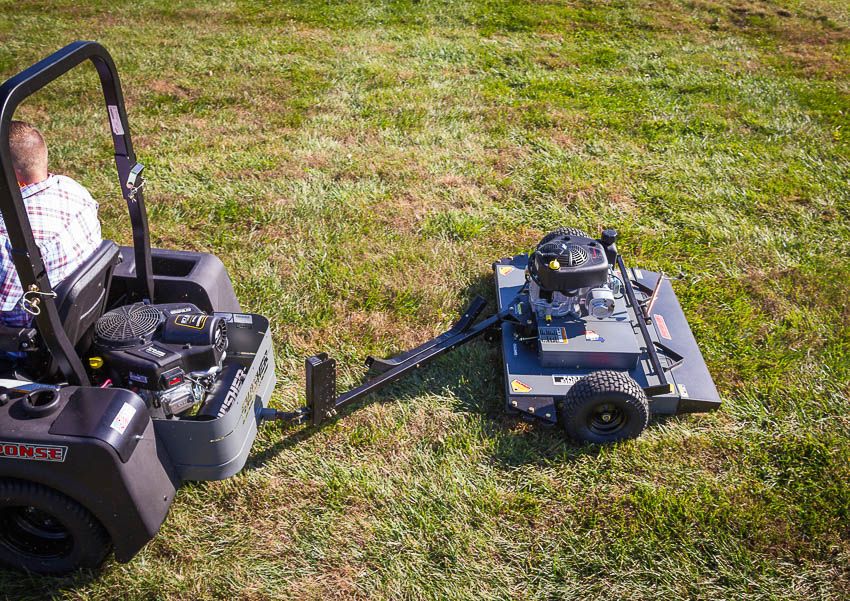
Finish-cut tow mowers are pulled behind a compatible vehicle to maintain grass with a lawn-like appearance. Their intended job is regular mowing, making the condition of your property an important starting point when choosing one.
What does “finish-cut” mean?
Finish-cut describes mowing intended to leave maintained grass with an even, finished appearance. It distinguishes this equipment from cutters intended primarily for coarse vegetation and brush clearing.
The result still depends on grass conditions, blade condition, mower setup, and operating speed. A finish mower works best when used within its manufacturer’s stated cutting capabilities.
How does a tow-behind finish mower work?
The towing vehicle moves the mower across the property while the mower’s cutting system trims the grass. The hitch connects the two machines, but that connection alone does not establish compatibility: towing capacity, attachment requirements, and operating limits must also match.
Check the individual product’s power system and controls rather than assuming that every tow mower operates like a tractor-powered attachment.
Where does a finish-cut tow mower make sense?
This category is worth considering for established lawns, open grassy acreage, and other areas maintained on a regular mowing schedule. A suitable tow mower can add mowing capability to equipment you already own, provided the complete setup is approved for that use.
For a broader comparison of equipment formats, browse our lawn mowers and match the machine to the vegetation, access, and finish your property requires.
Finish-Cut vs. Rough-Cut Tow Mowers and Other Alternatives
The right mower depends on what you are cutting and how you want the property to look afterward. Compare equipment by its intended application before comparing deck width or price.
Finish-cut vs. rough-cut tow mowers
Finish-cut equipment is intended for maintained grass and a lawn-like result. Rough-cut trail cutters serve a different purpose: managing coarser vegetation within each model’s rated capabilities.
If your property contains brush or woody growth, do not select a finish mower simply because it has a wide deck. Compare the vegetation ratings of suitable brush cutters before choosing clearing equipment.
Tow-behind finish mowers vs. PTO finish mowers
“Tow-behind” describes how equipment follows a vehicle; “PTO” identifies a power connection. These terms are not interchangeable. A tractor PTO mower requires the specified tractor connections and power compatibility, while the requirements of a tow mower depend on its particular design.
Read the product specifications to establish how the mower is powered, attached, and controlled. Do not assume that owning a tractor makes every mower compatible.
Adding a tow mower vs. using a riding mower or zero-turn alone
An approved tow-mower combination may expand the cutting path of a compatible riding mower. However, the longer equipment combination also needs room for turns, obstacles, and maneuvering.
Compare that arrangement with zero-turn mowers if your property has frequent turns or closely spaced landscaping. Consider the complete mowing route rather than judging either option by deck width alone.
How to Choose the Right Finish-Cut Tow Mower
Start with the area you actually mow, the space available to maneuver, and the vehicle you plan to use. These factors help narrow the selection before you compare individual specifications.
Match cutting width to acreage and access
A wider cutting deck can cover a broader strip on each pass, but only where the property provides enough access. Measure gates, passages, and storage openings against the mower’s overall dimensions, which may differ from its stated cutting width.
Compare usable mowing width after allowing for overlap. Trees, narrow routes, and repeated turns can reduce the advantage of a wider machine.
Account for terrain and obstacles
Assess surface changes, tight corners, and obstacles along your mowing route. The tow vehicle and mower follow different paths through a turn, so allow clearance for the entire combination.
Check the manufacturer’s terrain and slope restrictions before purchase. A mower that fits the available space may still be unsuitable for the ground conditions.
Check tow-vehicle and hitch compatibility
Verify the mower’s required hitch connection, hitch height, weight, and towing requirements against your vehicle’s specifications. ATV, UTV, lawn-tractor, and riding-mower compatibility must be confirmed for the particular combination.
Also check permitted operating speeds and access to required controls. The ability to pull a mower does not, by itself, establish that the vehicle can operate it as intended.
Finish-Cut Tow Mower Features That Matter
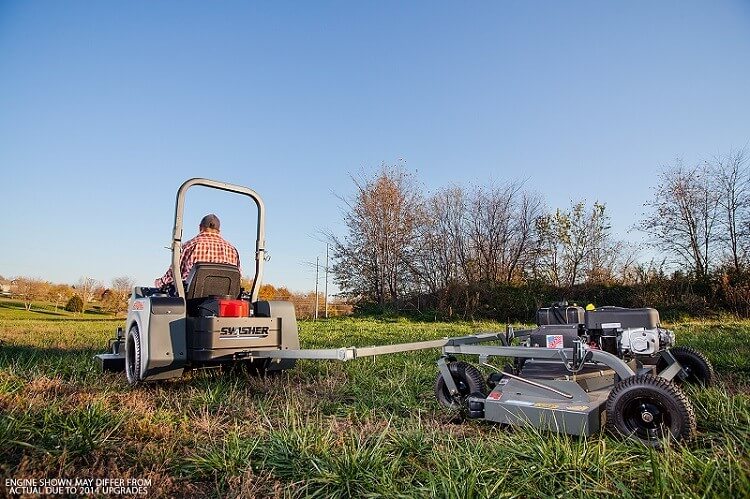
Compare the specifications published for each mower rather than assuming features are shared across the collection. Focus on details that affect cut quality, operation, and routine upkeep.
Cutting-height range and adjustment
Check whether the mower’s specified cutting-height range suits the grass you maintain. Review the adjustment procedure as well as the range, especially if you regularly change cutting height between areas.
An even result also depends on correct setup. Follow the model’s instructions for leveling and adjustment rather than relying only on the selected height setting.
Engine specifications and starting procedure
Review the listed engine specifications, starting procedure, and service requirements for the model you are considering. Engine output should be evaluated alongside cutting width and intended mowing conditions.
A larger engine rating alone does not establish a better finish or faster mowing. Match the complete machine to the workload.
Deck, blades, and discharge arrangement
Compare the documented deck construction, blade configuration, and discharge arrangement. These details help explain how the mower handles grass and where clippings leave the cutting area.
Plan mowing routes with the discharge direction in mind. For edges and confined spaces the mower cannot reach, string trimmers can complement routine lawn maintenance.
Wheel layout, controls, and service access
Review wheel placement and the mower’s overall layout when assessing maneuvering clearance and how it will follow your property’s contours. Check how the operator reaches and uses the controls in the intended towing setup.
Service access matters throughout ownership. Consult the manual for inspection points and maintenance procedures before deciding which layout suits your needs.
Offset Towing, Configurations, and Available Options
Configuration affects how a tow mower fits into your mowing setup. Only count on adjustments and options explicitly listed for the individual model; the category name does not establish what is included.
Inline vs. offset towing
Inline towing places the mower behind the towing vehicle. Offset towing positions the cutting path to one side, where the mower’s design permits that arrangement.
If offset capability is important, confirm the model’s supported positions and adjustment instructions. Do not assume every finish-cut tow mower offers an adjustable offset.
Coordinating cutting paths with a riding mower
Where the manufacturers permit combined mowing, the two cutting paths need enough overlap to avoid leaving an uncut strip. Effective coverage depends on the approved positioning of both machines.
Do not simply add the two deck widths to estimate usable coverage. Overlap, turns, and required clearances affect the width you can consistently mow.
Confirming adjustments and included equipment
Check the product listing for the supplied hitch components, controls, starting system, and any documented configuration choices. Confirm whether anything required for your intended setup must be purchased separately.
Treat accessories as model-specific. Verify manufacturer compatibility before adding or substituting components.
Finish-Cut Tow Mower Prices and Value
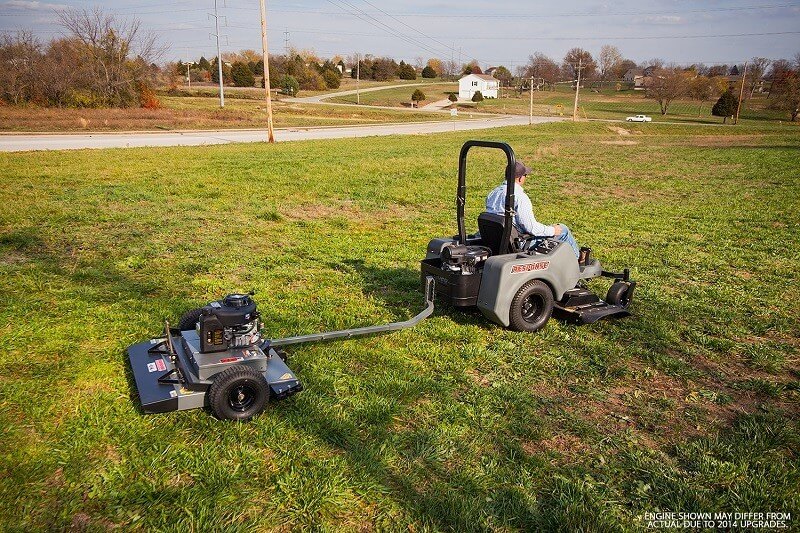
The best value is a mower that fits your property and works with your existing equipment. Compare the current product prices alongside specifications, setup requirements, and expected maintenance.
What drives price differences?
Differences in cutting width, engine specifications, construction, and included equipment can affect purchase price. Compare the actual specifications of similarly priced models to understand what each price includes.
A lower-priced mower may meet your needs fully. Paying more is worthwhile only when the additional capability or equipment benefits your application.
Balancing width and features with usable productivity
A wider deck can be valuable on open ground, but access restrictions and frequent turns may limit the benefit. Choose a width you can use efficiently across your regular mowing route.
Consider setup and adjustment time as well. The practical value of a mower depends on the complete job, including maneuvering, trimming, and routine upkeep.
Accounting for delivery, assembly, and ownership costs
Check the individual listing for shipping charges, delivery requirements, and assembly information. These details vary by product and should be included in your purchase comparison.
Allow for the maintenance items specified in the manual and confirm replacement-part pricing where available. Comparing the total cost of a suitable setup is more useful than comparing advertised mower prices alone.
Maintenance, Replacement Parts, and Warranty Support
Serviceability and documented warranty coverage belong in the buying decision. Before ordering, understand what the mower requires and how you will obtain the correct replacement parts.
Routine engine and cutting-system maintenance
Follow the manufacturer’s schedule for engine service, blade inspection, cleaning, and other required checks. Use the manual’s procedures for stopping and securing the machine before maintenance.
Inspect service items identified for your model, including belts where applicable. Address wear or damage before continuing operation.
Checking replacement-part availability
Locate the model number and parts documentation before buying replacement components. Similar appearance or cutting width does not establish that blades, belts, or other parts are interchangeable.
Confirm the correct part number and fitment for the specific mower. Clear parts documentation helps make future maintenance easier to plan.
Comparing warranty and service requirements
Read the written warranty for coverage periods, exclusions, maintenance obligations, and any differences based on use. Check whether engine coverage is addressed separately from the mower.
Confirm the service process and required purchase records before ordering. Base the comparison on the published terms rather than assuming every model includes the same support.

 -36%

 -22%
 -34%

 -13%
 -36%

 -18%

 -16%

 -3%Brave BRPFC112HE


