What Are Broadcast Spreaders?
Broadcast spreaders distribute granular material over a wide swath using a rotating spinner beneath a hopper. They help property owners and grounds crews apply compatible materials more efficiently than spreading them by hand.
How Broadcast Spreaders Work
Material moves through an adjustable opening in the hopper and drops onto a spinning disc that throws it outward. The opening controls material flow, while the spread pattern depends on the machine, material characteristics, and operating conditions.
Ground-driven and powered designs operate differently. Follow the individual model’s instructions for travel speed, spinner operation, and application settings.
Common Uses for Broadcast Spreaders
Broadcast spreaders are commonly used for grass seed and granular fertilizer. Certain models are designed for compatible salt or ice-melt products, but material suitability must be confirmed for the specific spreader.
These machines handle dry materials rather than liquid treatments. For liquid applications, compare property-maintenance sprayers and follow the treatment product’s application instructions.
Benefits of Wide-Area Spreading
A broadcast pattern covers a wider path than the hopper itself, helping reduce the number of passes across open ground. An appropriately sized hopper also reduces interruptions for refilling.
Accurate application still requires calibration and controlled overlap. A wide spread pattern improves coverage efficiency, but it does not automatically produce the correct application rate.
Types of Broadcast Spreaders
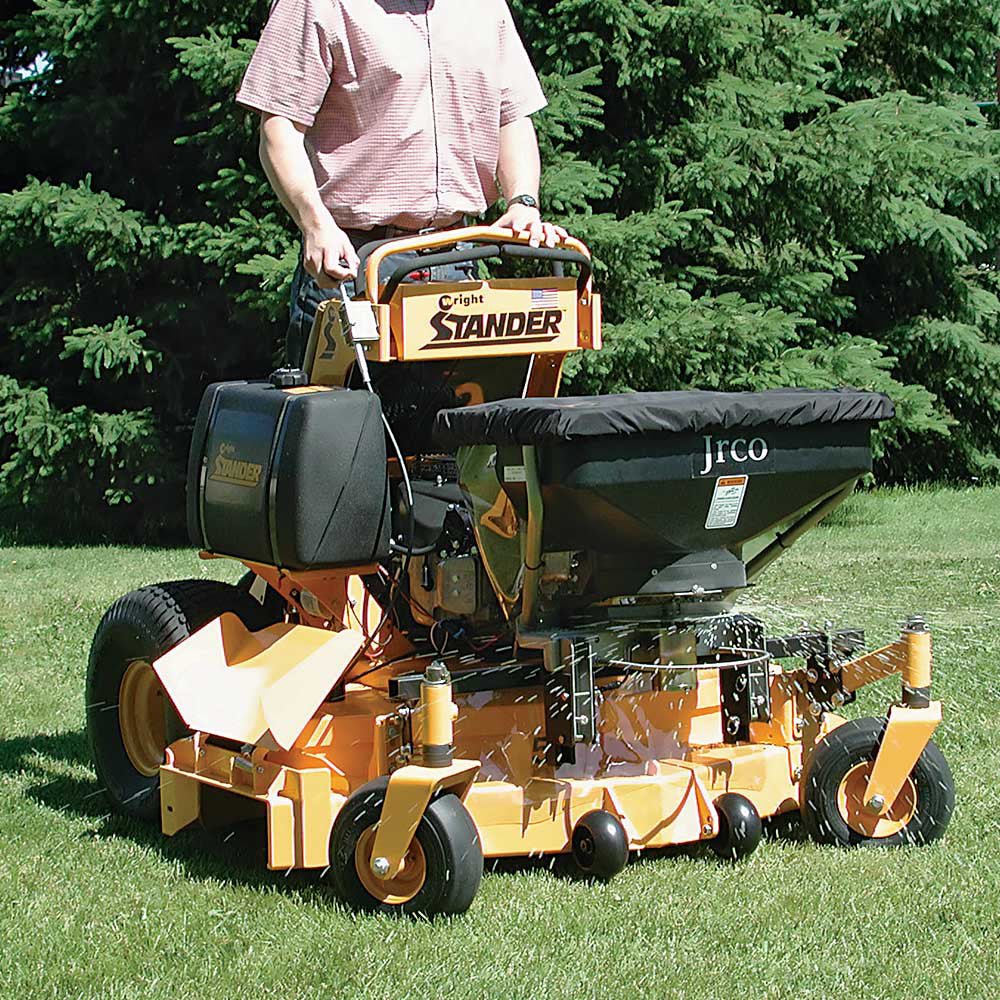
Push and equipment-mounted spreaders serve different operating needs. Start by deciding whether you want to walk behind a self-contained unit or use a spreader with compatible equipment you already own.
Push Broadcast Spreaders
Push spreaders let the operator guide the machine directly across the treatment area without a separate towing or carrying vehicle. They are useful where access, turning room, or smaller treatment areas favor a walk-behind approach.
Consider the loaded weight as well as hopper capacity. A larger hopper reduces refills, but pushing a full spreader across uneven or soft ground can require more effort.
Mower-Mounted Broadcast Spreaders
Mower-mounted configurations allow spreading with a compatible host machine. The assortment includes JRCO broadcaster configurations identified for walk-behind and stand-on mowers, with mounting and control requirements that vary by model.
If you are pairing a spreader with lawn-maintenance mowing equipment, verify the exact mower model and required mounting hardware. Do not assume compatibility with every walk-behind, stand-on, or zero-turn mower.
Utility-Vehicle Broadcast Spreaders
Utility-vehicle configurations can suit buyers who already use a compatible vehicle for grounds maintenance. Evaluate the spreader’s mounting arrangement, loaded weight, control location, and any electrical requirements before purchase.
A utility-vehicle designation does not establish universal ATV or UTV compatibility. Match the spreader’s documented requirements to the specific vehicle and confirm which installation components are included.
Broadcast Spreaders vs. Drop Spreaders
The main difference between broadcast and drop spreaders is where the material lands. Broadcast spreaders throw material outward, while drop spreaders release it beneath the machine within a more confined path.
Spread Width and Application Speed
A broadcast spreader can cover open ground with fewer passes because its spreading swath extends beyond the machine’s width. This makes the design useful for lawns, grounds, and other areas where broad coverage is desirable.
A drop spreader generally requires more closely spaced passes. Compare the effective working width rather than judging coverage by hopper size alone.
Placement Accuracy Around Edges and Beds
Drop spreaders offer more confined placement near planting beds, sidewalks, and other boundaries. Broadcast spreaders require additional attention at edges because material can travel beyond the intended treatment area.
Check whether a specific broadcast model provides documented pattern-control features. Do not assume an edge guard or deflector is included, and remove misplaced material according to the treatment product’s directions.
Which Spreader Type Fits Your Property?
Choose a broadcast design when covering open areas efficiently is the main priority. A drop design may be more appropriate where narrow spaces and precise boundaries dominate the job.
Consider the actual treatment area, including beds, paths, obstacles, and access points. A property with extensive lawn can have different spreading requirements from a similarly sized property divided into small sections.
How to Choose the Right Broadcast Spreader
Choose a spreader by matching its working capacity and operating configuration to the job. Property size matters, but material rate, terrain, access, and equipment compatibility are equally important.
Match Capacity to Property Size and Refill Needs
Hopper capacity describes how much material a spreader can carry, not how much ground it will treat. Coverage per load depends on the material and its required application rate.
For example, 80 pounds of material applied at 4 pounds per 1,000 square feet would theoretically treat 20,000 square feet. That calculation applies only when the spreader is rated to carry the material and the application rate matches the product label.
Compare Spread Width and Effective Coverage
The distance material travels is not necessarily the correct spacing between passes. An effective application pattern may require overlap to distribute material evenly across the treated area.
Use the manufacturer’s guidance and a calibration check to establish working width. Avoid estimating total productivity from the maximum advertised throwing distance alone.
Choose for Terrain and Maneuverability
Consider surface firmness, slopes, turning space, and the effort required to move a loaded hopper. Wheels, balance, and the machine’s overall dimensions can affect handling around obstacles and through gates.
For a broader lawn-renovation project, evaluate spreading alongside tow-behind aeration equipment when soil compaction also needs attention. Aeration and spreading perform different tasks; choose each machine for the condition being addressed.
Check Mounting, Controls, and Power Requirements
For equipment-mounted spreaders, verify the host-machine fit, mounting hardware, operating controls, and power requirements. Confirm the permissible loaded weight and any operating limits specified by both manufacturers.
Control access matters during use. The operator should be able to start and stop material flow using the intended control arrangement without modifying the equipment or bypassing safety systems.
Broadcast Spreaders for Seed, Fertilizer, and Other Materials
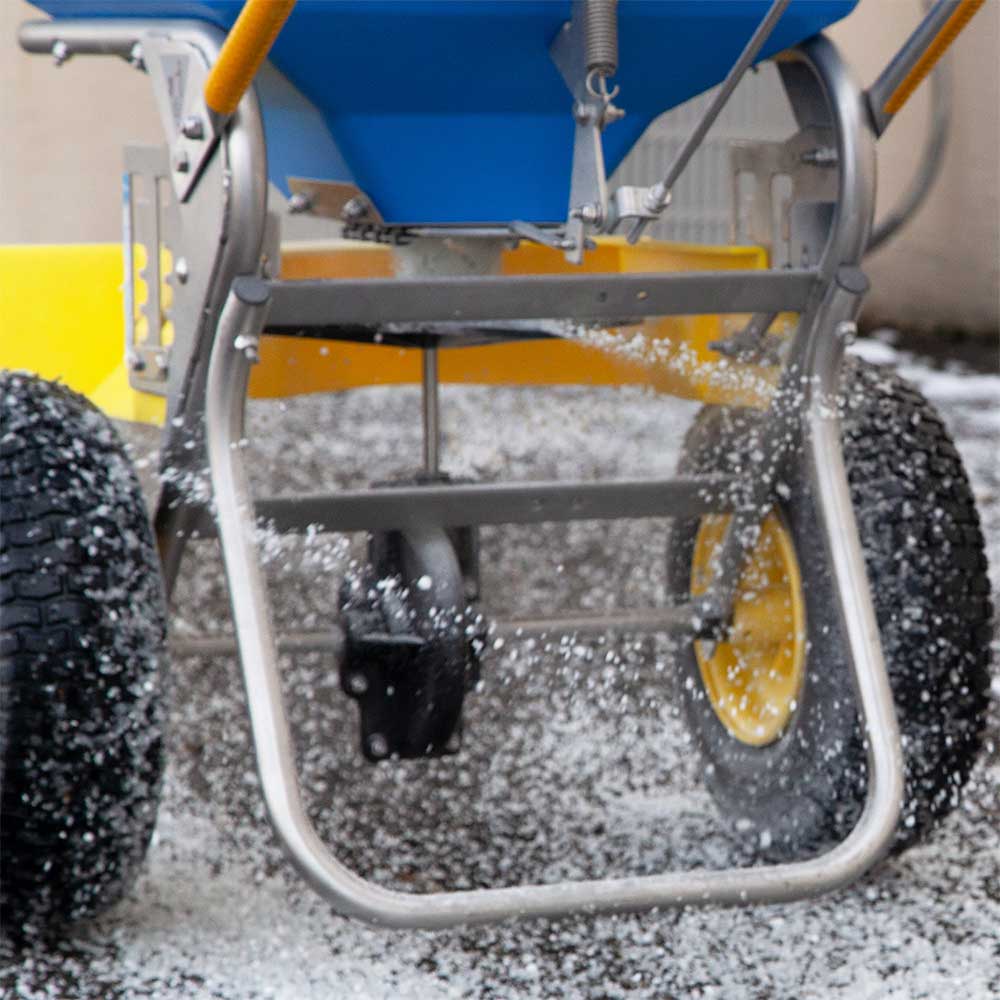
Material compatibility is a primary buying consideration. Particle size, density, moisture, and flow characteristics influence whether a product feeds properly and how it spreads.
Choosing a Spreader for Grass Seed
Check that the spreader supports the seed you intend to apply and can meter it at the recommended rate. Different seed sizes and blends can flow differently, so a setting used for one product may not suit another.
Seed-to-soil contact also matters for establishment. Where excessive thatch is part of the problem, evaluate lawn dethatchers as a separate preparation step rather than expecting a spreader to correct the surface condition.
Choosing a Spreader for Granular Fertilizer
Select a model approved for the fertilizer’s physical form and intended application. Granule size and product density affect flow, so use settings supplied for the specific spreader and fertilizer when available.
Calibrate before treating the full area. Excess fertilizer can damage turf, while insufficient application can fail to deliver the intended treatment.
Checking Salt and Ice-Melt Compatibility
Use salt or ice melt only in a spreader specifically approved for the material. A lawn spreader’s suitability for fertilizer does not establish that it can handle coarse deicing products.
Compare the manufacturer’s material recommendations and cleaning instructions. Corrosion-resistant construction can be valuable, but it does not eliminate the need to remove residue after use.
Confirming Other Granular Materials
Do not assume that lime, sand, compost, or damp materials will feed through a conventional broadcast spreader. Some materials bridge over the opening, clog the mechanism, or require equipment designed for a different application.
Powdered and pelletized forms of the same substance can behave differently. Confirm the exact material form with the spreader manufacturer before purchasing or loading the machine.
Broadcast Spreader Features, Options, and Accessories

Useful features make the spreader easier to control, match to the job, and maintain. Compare documented equipment details rather than assuming that similarly sized hoppers provide the same operating experience.
Flow Controls and Shutoff Operation
Flow adjustment determines how much material leaves the hopper, while the shutoff lets the operator stop discharge between treatment areas. A clearly repeatable setting helps when returning to a previously calibrated application.
The supplied assortment identifies cable-control and foot-control JRCO configurations. Compare the specific control arrangement with your host machine and operating position rather than treating these systems as interchangeable.
Hopper, Frame, and Corrosion Resistance
Review which components use stainless steel or other specified construction materials. A stainless steel designation should not be interpreted as a claim that every component is stainless or immune to corrosion.
Material residue, storage conditions, and cleaning practices affect equipment condition. Follow the model’s maintenance instructions, especially after fertilizer or deicing applications.
Wheels and Drive Components
On a push spreader, wheel design and the drive mechanism affect how the machine moves and distributes material. Evaluate the documented wheel specifications alongside the surfaces you expect to cross.
On a powered broadcaster, confirm how spinner speed is controlled and how that relates to material flow. Separate spinner and discharge controls, where documented, should be evaluated according to the manufacturer’s operating procedure.
Included Hardware and Optional Equipment
Check the product listing for mounting components, controls, and other included equipment. Where additional accessories are listed, verify their compatibility with the exact spreader model before ordering.
Do not assume that covers, edge guards, wiring connections, or installation hardware are standard. Build the purchase around documented components needed for your intended setup.
Broadcast Spreader Prices and Value
Compare spreader prices against the equipment configuration and work you need to complete. The lowest initial price may not represent the lowest total purchase cost if additional compatible components are required.
Price Differences Between Spreader Types
Push and equipment-mounted spreaders have different construction and installation requirements. Compare current product prices alongside their controls, capacity, and intended applications rather than assuming one configuration is always less expensive.
For a mounted unit, include the cost of any required hardware or electrical components that are not supplied. Using equipment you already own is valuable only when the combination is compatible.
How Capacity and Construction Affect Value
A larger hopper can reduce refills, while suitable construction materials can support the intended workload and treatment products. Those benefits matter most when they address a recurring need.
A smaller spreader may offer better value for restricted access or occasional use. Compare loaded handling, storage space, and application control alongside carrying capacity.
Compare the Complete Purchase Cost
Review the listed equipment, required accessories, shipping charges, and assembly or installation requirements before comparing totals. Delivery arrangements and included components can vary by product.
Use the current product listing for pricing and availability. Avoid basing a purchase on a category-wide assumption about delivery service, lead time, or included installation equipment.
Warranty, Serviceability, and Replacement Parts
Check the specific warranty terms, maintenance requirements, and availability of replacement components. Accessible service information can be particularly useful for equipment used frequently throughout a season.
Long-term value comes from matching the spreader to the material, property, and workload, then maintaining it as directed. Additional capacity or features provide little benefit if the machine does not fit the job.


 -13%

 -13%

 -9%

 -3%

 -9%

 -13%

 -24%
 -7%

 -13%
 -6%

 -10%

 -3%

 -59%


