Gas Log Splitters: What They Are & How They Work
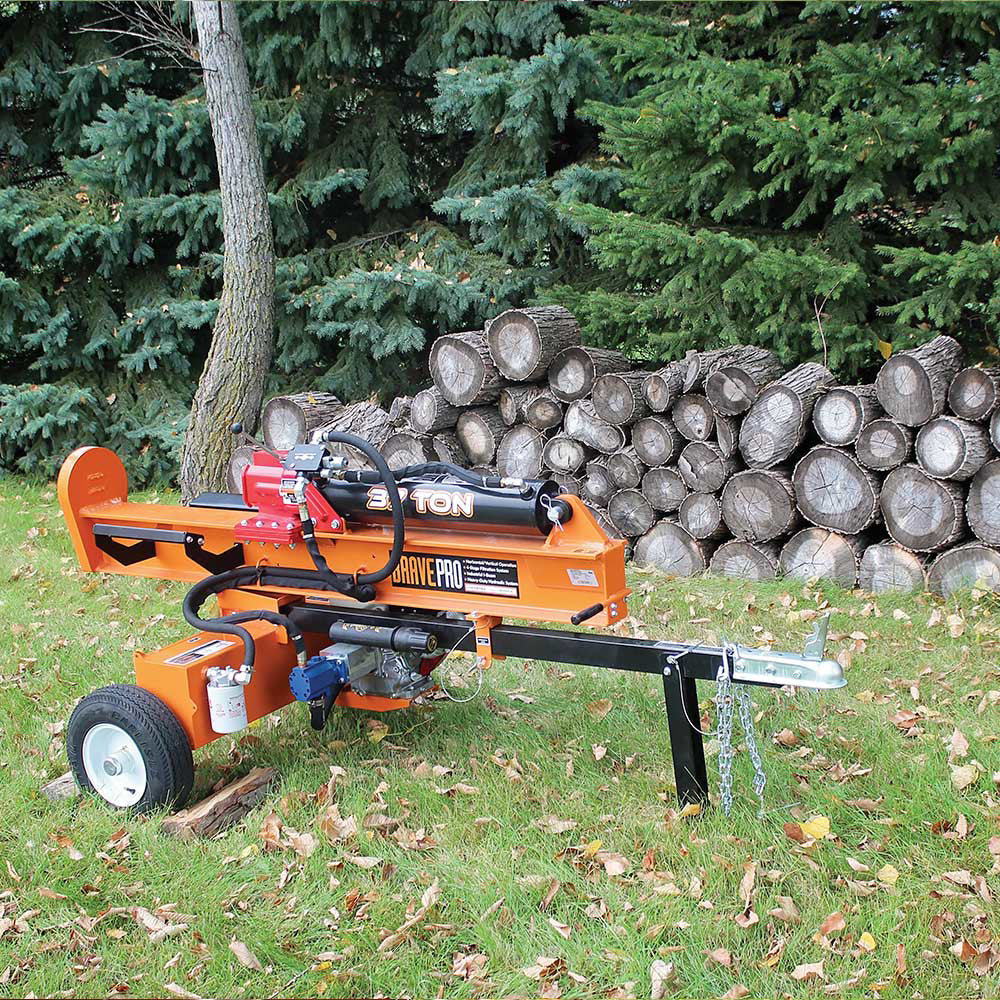
A gas log splitter is a self-contained wood-splitting machine powered by a gasoline engine. Most gas models use a hydraulic system to generate the force needed to drive a wedge through a log or move the log against a splitting wedge. They are available in a broad range of sizes and configurations for homeowners, acreage owners, farms, firewood processors, and other users.
What Is a Gas Log Splitter?
A gas-powered log splitter mechanically separates rounds or sections of wood into smaller pieces for firewood, drying, storage, or further processing. Unlike an electric log splitter, a gas model does not need to remain near a suitable electrical power source, making it practical when the woodpile and splitting area are away from buildings or outlets.
Gas splitters are commonly rated by splitting force in tons, but tonnage is only one part of choosing a machine. Log capacity, cycle time, operating orientation, portability, and the type and quantity of wood you process can all affect which splitter is appropriate.
How Does a Gas-Powered Log Splitter Work?
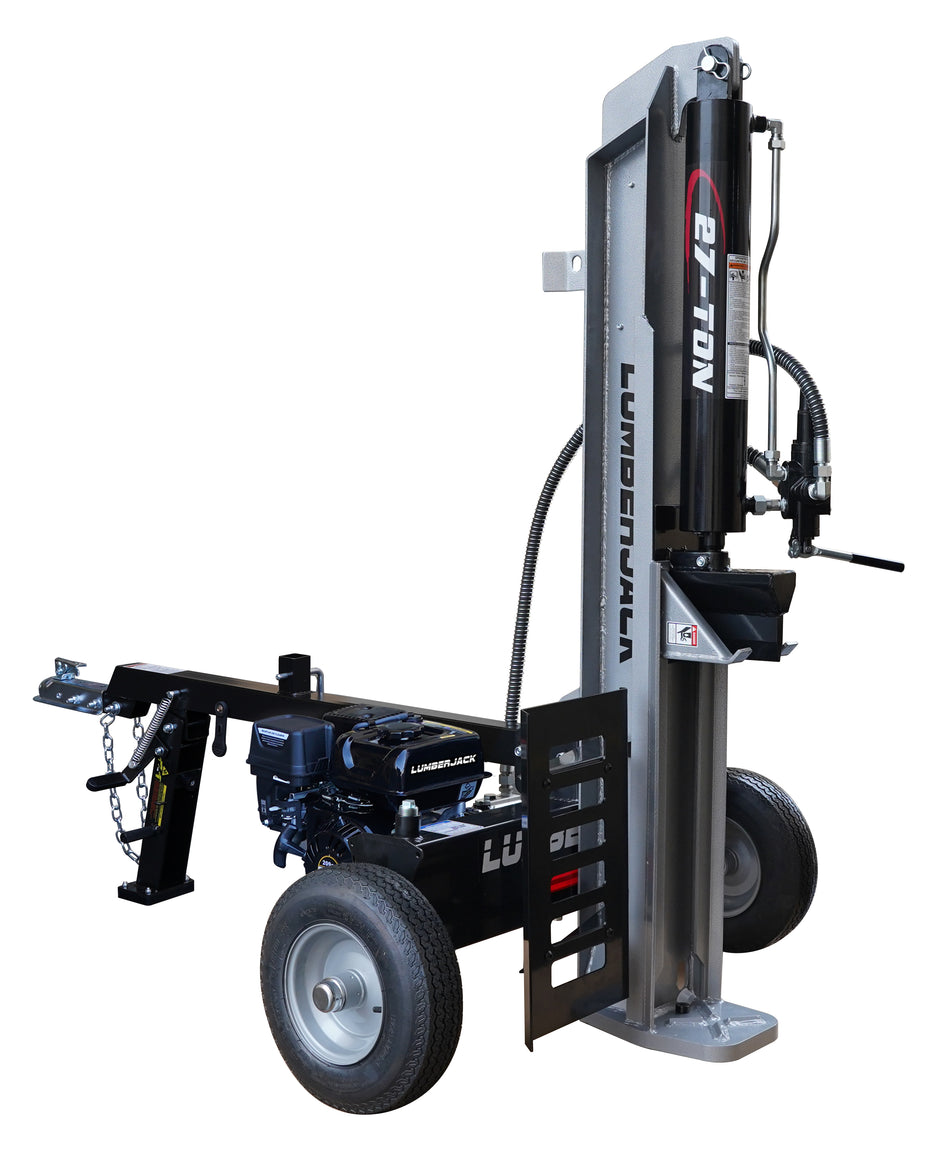
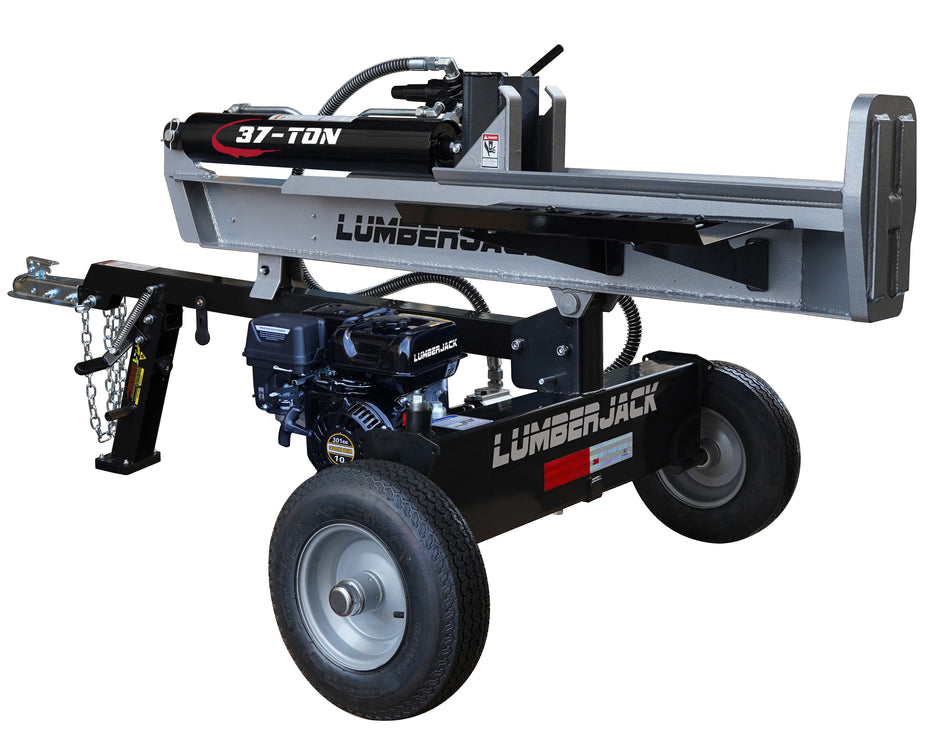
On a conventional gas hydraulic splitter, the engine powers a hydraulic pump. Pressurized hydraulic fluid moves a cylinder and ram, generating the force used during the splitting stroke. The exact engine, hydraulic components, splitting force, cycle time, and wedge arrangement vary by model.
This is different from a kinetic log splitter, which stores rotational energy and rapidly releases it during the splitting stroke rather than relying on hydraulic pressure for that stroke.
Who Should Consider a Gas Log Splitter?
Gas models are particularly relevant for people who regularly process substantial amounts of firewood, split larger or more difficult rounds, or need to work where electrical power is unavailable or inconvenient. That can include homeowners who heat with wood, rural property owners, farms and ranches, tree-service users, and firewood sellers.
Gas is not automatically the right power source for everyone. Someone processing smaller quantities of manageable firewood near an appropriate electrical source may prefer the lower noise, lack of gasoline, and reduced engine-related maintenance of an electric machine.
Why Choose a Gas-Powered Log Splitter?
Gas-powered splitters are commonly chosen when splitting capability, mobility, and firewood-processing volume are important. Their main advantage is not simply having a gasoline engine; it is the combination of a self-contained power source with the range of splitting-force ratings and machine configurations available.
Splitting Force for Demanding Wood
Gas log splitters are available across a wide range of tonnage ratings, including machines intended for demanding wood and higher-volume use. Greater splitting force can be valuable for larger, harder, knotty, green, or irregular rounds, although no tonnage rating guarantees that a machine will split every log.
Rather than buying solely on the largest tonnage number, consider the actual wood you process. Diameter, species, density, moisture, knots, grain, and log length can all influence splitting difficulty.
Work Away From Electrical Power
Because the engine supplies the machine's power, a gas splitter can operate without being connected to an electrical outlet. That can be useful when splitting near a woodlot, around acreage, on a farm, or simply at a woodpile located well away from the house.
Process Larger Quantities of Firewood
Gas machines are often a strong fit for users processing substantial quantities of wood. For higher-volume work, however, tonnage should be evaluated alongside cycle time, wedge design, log handling, operating position, and overall workflow. A splitter that reduces unnecessary handling or waiting can matter just as much as maximum force.
Match the Power Source to the Job
A standalone gas splitter is only one way to process firewood. Buyers who already own suitable equipment may also want to compare 3-point tractor log splitters or skid steer log splitters. Those alternatives can integrate with existing equipment but require careful compatibility checks.
How to Choose the Best Gas Log Splitter for Your Needs
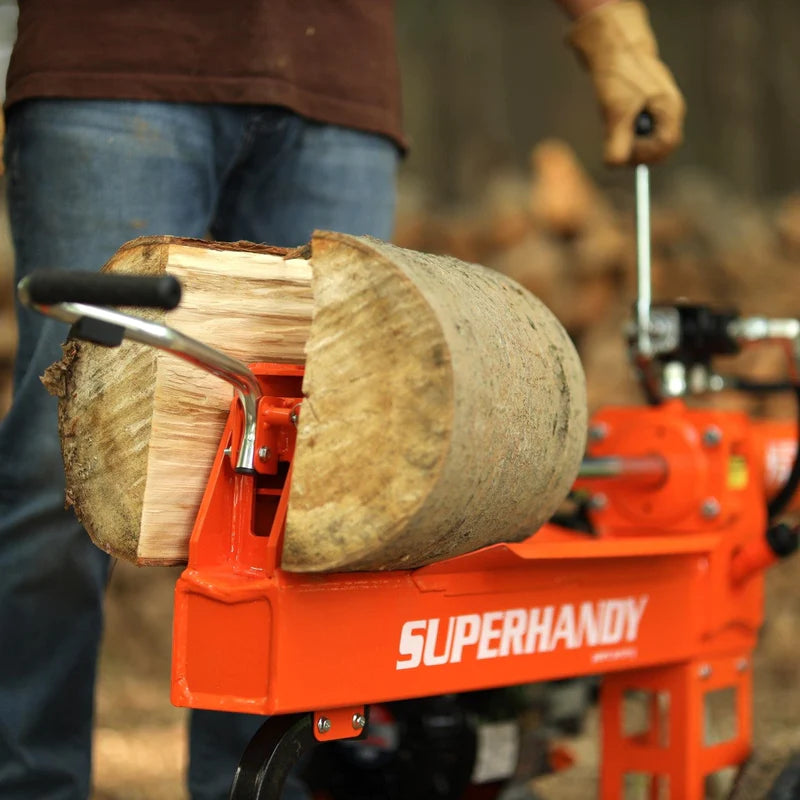
The best gas log splitter is the one whose capabilities fit your wood and workload—not necessarily the model with the highest tonnage. Start with the rounds you routinely split, then compare splitting force, capacity, cycle time, orientation, mobility, and other specifications that affect how you will actually use the machine.
Choose the Right Tonnage
Rated splitting force is a useful starting point because it indicates the amount of force the machine is designed to generate. Gas splitters may be available in 20-ton, 25-ton, 30-ton, 35-ton, 40-ton, and other configurations, depending on the current product assortment.
Higher tonnage can provide additional capability for difficult wood, but it should not be treated as a universal measure of quality. A properly matched lower-tonnage machine can make more sense than a larger splitter when the user's logs and workload do not require the additional force.
Match the Splitter to Your Logs & Wood Type
Think about the largest and most difficult wood you process regularly rather than only your easiest logs. Larger diameters, dense hardwoods, green wood, knots, crotches, and twisted or irregular grain can place greater demands on a splitter than smaller, straight-grained, seasoned rounds.
Check each model's rated maximum log dimensions as well. Maximum log length and diameter are model-specific and should never be assumed based only on tonnage.
Consider Horizontal vs. Vertical Operation
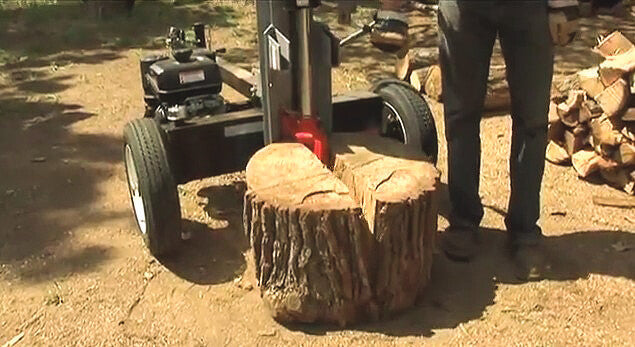
Horizontal splitting works well when rounds can be comfortably lifted onto the splitter's beam or work area. Some models also convert to vertical operation, allowing large, heavy rounds to be rolled or positioned for splitting without lifting them as high.
If vertical operation matters to you, verify that capability on the individual product. Not every gas log splitter operates in both positions.
Compare Cycle Time & Productivity
Cycle time becomes increasingly important as the amount of wood being processed grows. A shorter cycle can reduce waiting between splits, but the published number should be considered together with splitting force, wedge configuration, log handling, and operator workflow.
For someone processing several cords of firewood, small workflow differences can accumulate over many splitting cycles. Consider how easily rounds can be loaded, split pieces cleared, and the next log positioned—not simply which machine has the fastest specification.
Consider Portability, Storage & Transport
Determine whether your splitter will stay near one woodpile or routinely move around a property or between locations. Wheels, hitches, dimensions, and machine weight can all affect mobility and storage.
Do not assume a splitter can be towed at highway speeds simply because it has wheels or a hitch. Towing speeds and public-road suitability are model-specific and should always be verified against the manufacturer's specifications.
Gas Log Splitter Tonnage & Splitting Capacity
Choosing splitting capacity requires more than matching a single tonnage number to a log diameter. Wood varies considerably, so the force required to split two similarly sized rounds can differ based on species, moisture, knots, grain, and other characteristics. Use tonnage together with the rest of the machine's specifications to evaluate capability.
How Much Tonnage Do You Need?
There is no single tonnage rating that is correct for every homeowner or every type of firewood. Smaller, straight-grained, seasoned rounds generally place fewer demands on a splitter than large, green, knotty, dense, or irregular wood.
Think about both your typical logs and the difficult rounds you encounter often enough to matter. Extra splitting force can provide useful capability, but buying substantially more machine than the job requires can add cost without necessarily improving the aspects of performance you value most.
Log Diameter & Length Matter
Diameter can increase splitting difficulty, but it is not the only factor. Log length can also affect the demands placed on the machine, and each splitter has its own rated log capacity. Always compare the manufacturer's stated maximum log length and diameter for the specific models you are considering.
Hardwood, Softwood & Difficult Grain
Wood species and structure can make a major difference. Dense hardwood, knots, crotches, twisted grain, and other irregularities can require considerably more effort to split than clean, straight-grained wood. Green and seasoned wood may also behave differently depending on the species and log.
When Higher Tonnage Makes Sense
A higher-tonnage gas log splitter may be worth considering when difficult rounds are a routine part of your workload rather than an occasional exception. Users processing large quantities of varied wood may also value additional splitting-force capacity, provided the rest of the machine fits their productivity and handling requirements.
If your work involves firewood from the cutting stage through storage, related equipment such as chainsaws and firewood racks can support other parts of the workflow.
Gas Log Splitter Features & Configurations
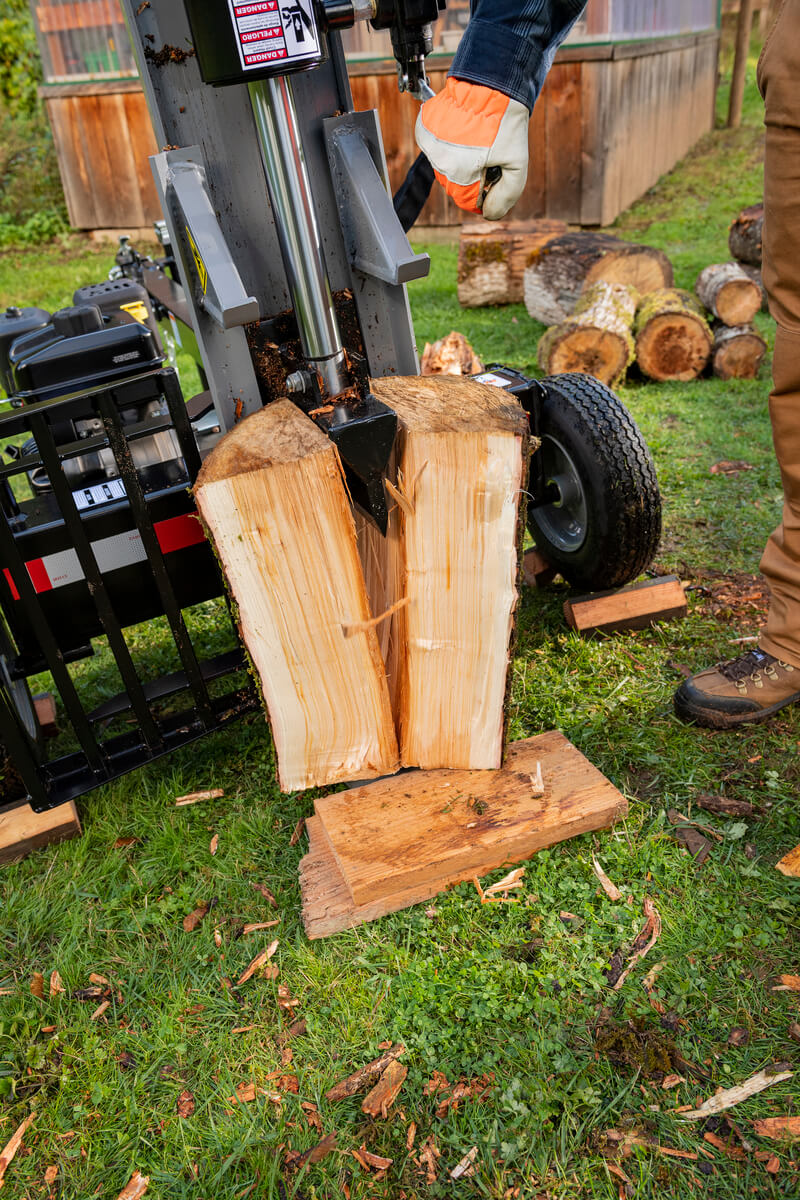
Two gas log splitters with similar tonnage ratings can provide different operating experiences. Comparing the complete machine—including its hydraulic system, cycle time, operating position, log-handling features, and mobility—provides a better basis for choosing than splitting force alone.
Horizontal vs. Vertical Splitting
Horizontal models provide a straightforward working position for rounds that can be lifted onto the beam. Horizontal/vertical splitters add another option for large, heavy rounds by allowing certain logs to be positioned closer to ground level during vertical operation.
Neither configuration eliminates the need for safe log handling. Follow the manufacturer's procedures for positioning wood and keep hands and other body parts away from the wedge and splitting zone.
Engine & Hydraulic System
The engine supplies power to the hydraulic system on a conventional gas hydraulic splitter, while the pump, cylinder, valves, and related components convert that power into splitting action. Engine manufacturer, displacement or horsepower, hydraulic flow, pressure, and other specifications differ by model, so compare the individual product specifications rather than assuming they are uniform across a tonnage class.
Cycle Time & Auto-Return
Cycle time helps indicate how quickly the splitting mechanism can complete its operating cycle. This can have a meaningful effect on productivity when processing a large pile of wood. Features such as auto-return may also affect workflow when offered on a particular model.
Wedges, Log Cradles & Work Areas
Wedge configuration and log-handling components can influence how efficiently you work. Depending on the model, features or compatible log splitter accessories may include different wedge arrangements, cradles, work tables, covers, or other equipment. Verify compatibility before adding an accessory to a specific splitter.
Wheels, Hitches & Towable Designs
Mobility features can make it easier to reposition a splitter around a property or transport it as permitted by the manufacturer. However, a hitch or wheel-equipped design does not by itself establish a safe towing speed or make a machine legal for public-road use. Check the individual splitter's towing instructions and limitations before transport.
Gas vs. Electric Log Splitters
A gas log splitter and an electric splitter accomplish the same basic job but suit different working conditions. Gas is commonly selected for mobility, demanding applications, and higher-volume firewood processing, while electric power can be attractive for residential work near a suitable power source.
Splitting Power & Capacity
Gas log splitters are often available in higher splitting-force configurations than smaller electric machines, making gas a common choice for demanding or higher-volume applications. Specifications vary widely, however, and power source alone does not determine what a particular machine can handle.
Portability & Power Source
A gas machine can operate independently of an electrical outlet, which gives users more flexibility when the splitting area changes or is located away from electrical service. Electric models require an appropriate power source but eliminate the need to keep gasoline on hand.
Noise, Exhaust & Maintenance
Electric splitters generally operate with less noise than typical gasoline-powered machines and produce no engine exhaust. They also avoid gasoline-engine maintenance. Gas models require fuel and routine engine care but provide the advantage of a self-contained power source.
When Gas or Electric Makes More Sense
Gas can make sense when you routinely process substantial quantities of firewood, need greater mobility, or frequently work away from electricity. Electric can make sense for smaller-scale residential processing where suitable electrical power is readily available and the machine's rated capacity matches the wood.
Neither power source is universally better. Compare your wood, splitting volume, work location, desired capability, and maintenance preferences when deciding between gas and electric.
Gas Log Splitter Prices, Ownership & Long-Term Value
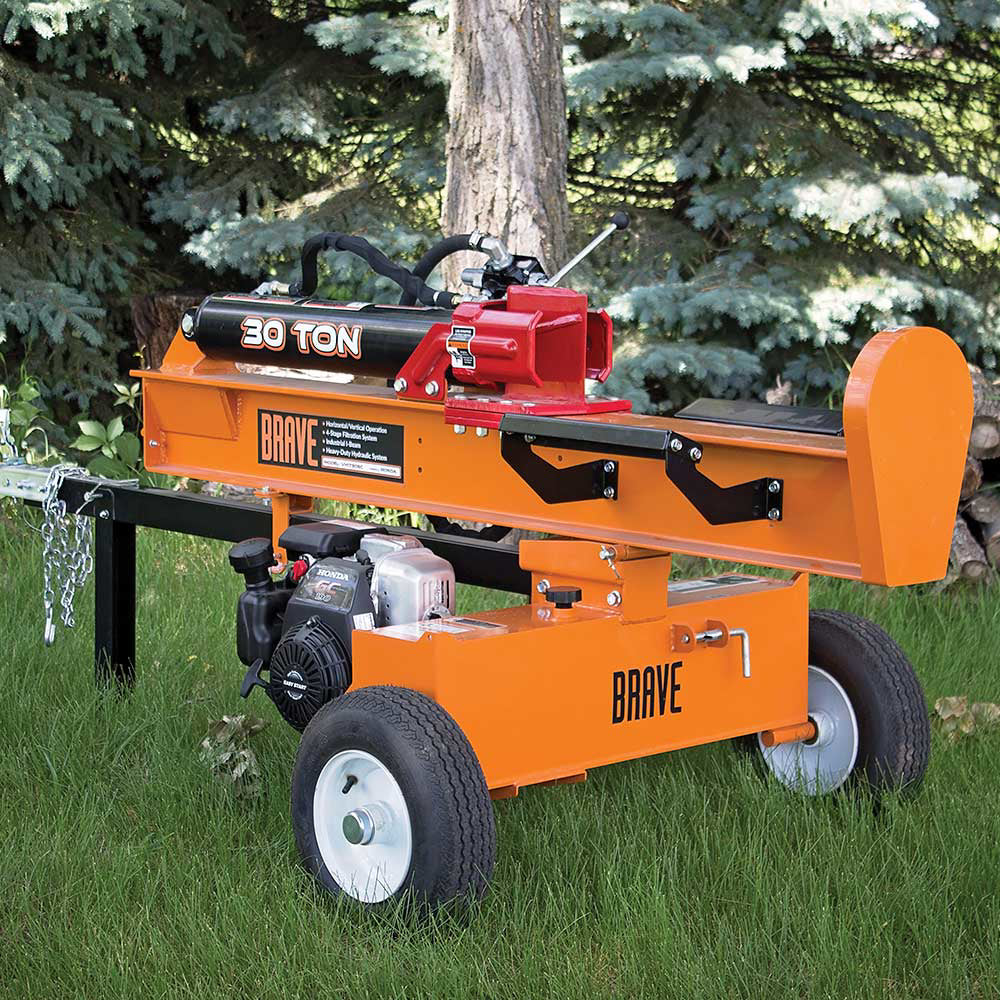
Gas log splitter prices vary because the machines differ in splitting force, engines, hydraulic systems, capacities, configurations, features, and intended workloads. Comparing price is most useful after determining what capabilities you actually need.
What Affects Gas Log Splitter Prices?
Tonnage is one factor, but it is not the only reason prices differ. Engine specifications, hydraulic components, cycle time, log capacity, horizontal/vertical capability, construction, log-handling features, mobility features, and other model-specific details can all contribute to the purchase price.
Pay for Features That Match Your Workload
A feature has value when it solves a problem you actually encounter. Vertical operation may matter considerably to someone routinely dealing with rounds that are difficult to lift, while cycle time may carry greater weight for a user processing several cords. Another buyer may care more about compact storage or moving the machine around acreage.
Evaluate the whole splitter around your application instead of assuming the most expensive or highest-tonnage model is automatically the best choice.
Fuel & Routine Maintenance
Ownership costs extend beyond the initial purchase. Gas-powered hydraulic splitters require fuel and model-specific maintenance for the engine and hydraulic system. Follow the manufacturer's maintenance schedule for items such as engine service, hydraulic fluid, filters, hoses, fittings, and other components applicable to the machine.
Evaluate Productivity as Part of Value
For frequent users, long-term value can include the amount of work a splitter lets you complete efficiently—not simply its purchase price. Splitting force, cycle time, log handling, operating orientation, and ease of moving or positioning the machine can all affect productivity over repeated use.
Compare the Machine, Not Just the Tonnage
Two machines with the same advertised splitting force can differ in specifications, features, configuration, and intended application. Compare the details of individual models and choose based on the wood you split, how much you process, where you work, and which features will make that work easier.


 -19%
 -27%

 -21%

 -12%

 -17%

 -8%

 -13%

 -2%

 -14%

 -15%

 -24%

 -19%


 -7%


 -14%

 -4%

 -15%
 -8%


